
Checking Criminal History in Easley
Easley records split by the office that made or decided the record. Police incident and collision reports stay with Easley Police Department. City traffic, misdemeanor, and ordinance matters go through Easley Municipal Court. A case that moves beyond Easley may appear in the Pickens County Public Index, while a statewide name-based history comes from SLED CATCH. Start with the event and agency, then widen the search only when the first source does not answer the question.
- Ask Easley Police Records for the incident or collision report, using a report number, date, location, and photo identification when available.
- Send the Easley FOIA form by email or mail when the needed police material is not available at the records window.
- Search Easley Municipal Court by the identifier tied to the citation, driver, plate, person, or business.
- Check Pickens County court and detention sources if the case or person moved outside city custody.
- Use SLED CATCH for a paid South Carolina name search, while remembering that it excludes wanted-person information.
This order helps prevent a common mismatch. An Easley police report describes the event as recorded by the officer. A booking record marks intake. The Easley Municipal Court docket shows what charge reached court and how it ended. None should be treated as a substitute for the others.
Easley Court Search Routes
Easley's court portal offers more search paths than many municipal systems. A reader can use citation number and date of birth, driver license and issuing state with date of birth, Social Security number with date of birth, plate and state, first and last name with date of birth, or a business name. Dates of birth use the MM/DD/YYYY format. The state menu covers the states and District of Columbia.
The official Easley court search is the source for the portal view shown below.
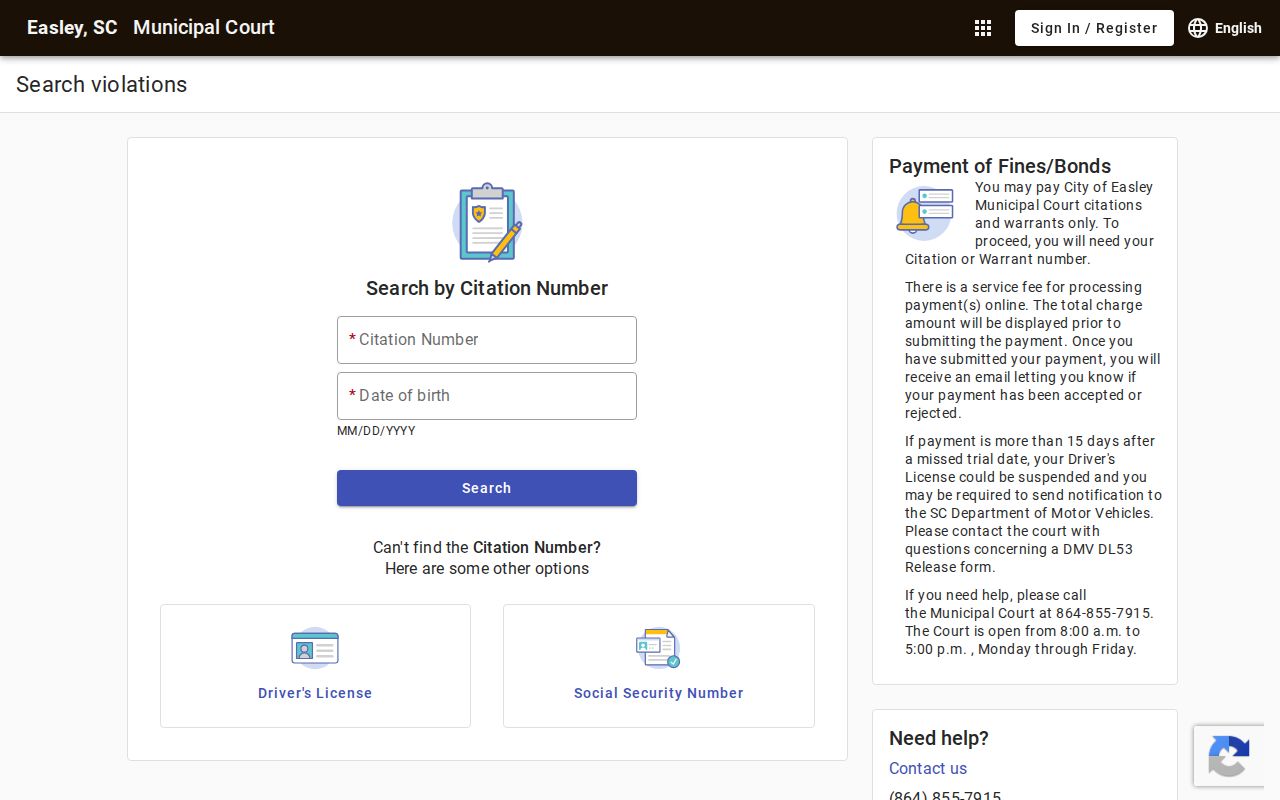
The range of fields makes a precise Easley search possible, but it does not expand the portal's jurisdiction. It covers City of Easley citations and warrants, not every Pickens County case.
Easley Police Department Records
Easley Police Department operates around the clock at 220 North West Main Street, Easley, SC 29640. The nonemergency line is 864-859-4025. Its records staff handle collision reports, incident reports, public-record requests, and discovery from the same local records channel. The direct records number is 864-855-7923, and the records email is records@easleypd.org.
The records counter is open Monday through Friday from 8:30 a.m. to 5 p.m., but it closes each day from noon until 1:30 p.m. That midday gap matters when planning an in-person visit. Easley requires photo identification for a report request. Since no official arrest blotter or police app was found, a direct request remains the sound route for police-created files.
Easley Police FOIA Requests
When a report is not handed out through the routine records window, Easley accepts its FOIA form by email or mail to the Records Division. Describe an existing file instead of asking Easley Police Department to research a topic. A useful request names the incident date, location, people involved, report number if known, and the exact part sought. This helps staff separate an incident report from court pleadings or jail material held elsewhere.
South Carolina's timing rule gives Easley ten business days to decide whether newer records are available and twenty business days for records more than two years old. That is a determination period, not a promise that copies will arrive on the same day. Easley says requests are handled in the order received. Active investigative details, juvenile material, protected victim data, and other exempt content may be withheld or redacted while releasable portions are produced.
A request for discovery should follow the channel and case rules given by Easley Police or Easley Municipal Court. Discovery is material exchanged in a pending case, so it is not always the same package a member of the public receives through FOIA. State the role of the requester and the known case details without assuming that one form grants access to every part of an investigation.
Easley Arrests and Bookings
An Easley arrest does not always begin at the county jail. Easley Police Department says arrestees first go to the Easley Law Enforcement Center for booking and arraignment. After bond is addressed, the person may be released from city handling or transferred to the Pickens County Detention Center. The two-stage path means a recent city arrest can be absent from a county custody view during the early part of the process.
For a fresh arrest, call the Easley nonemergency line or records unit first. Then check county detention if a transfer may have occurred. Search Easley court for the citation or warrant, and look to the county Public Index only when the prosecution reached a county court. The broader Pickens County arrest lookup explains county booking and agency routes without changing who owns the original Easley report.
Easley City Citation Limits
The municipal portal can look broad because it accepts several types of personal and vehicle data. Its scope is still narrow. Only City of Easley citations and warrants may be paid there. A Highway Patrol matter, Clemson case, county warrant, or General Sessions prosecution belongs to another office even when the person lives in Easley.
Payment also should not be confused with a full court-file request. The portal discloses a processing fee before payment, but the research did not establish a separate municipal copy-fee schedule. For docket history, an official disposition, or a certified record, contact Easley Municipal Court at 864-855-7915. A same-name portal hit should be checked against date of birth and the citation details before anyone treats it as the intended case.
Municipal Court Records in Easley
Easley Municipal Court sits at the Law Enforcement Center and hears city misdemeanor criminal cases, traffic matters, and ordinance violations. Its online portal is the quickest route when a known identifier fits one of the six search modes. The clerk remains the source for a court record that is not shown online, for clarification about a city warrant, and for an official copy of the disposition.
| Court Name | Easley Municipal Court |
|---|---|
| Case Types Heard | City misdemeanor criminal, traffic, and ordinance matters |
| Case Lookup Channel | Six-mode online portal or court clerk at 864-855-7915 |
| What the Docket Shows | City citation or warrant information tied to the selected search identifiers |
| Copies & Fees | Ask the clerk for copies; the payment portal shows its processing fee before payment |
South Carolina Judicial Branch warns that only some municipal records appear in county Public Index systems. A missing Pickens County result therefore does not erase a city docket. Search or call the Easley court separately when Easley Police issued the citation.
Easley Booking Transfer Timeline
The first entry in an Easley custody trail is city intake. Booking records can include the intake time, initial charge, photograph, fingerprints, bond or hold, and later release or transfer. An arraignment may follow at Easley level. If detention continues, Easley can transfer the person to Pickens County Detention, where a separate jail entry is made.
That shift explains why two official sources can show different times or labels without either being wrong. The police file reflects the arresting agency's work. Easley booking entry reflects initial custody. The county roster reflects county acceptance after transfer. A later court case can amend, dismiss, or replace the charge listed at arrest. Read the final disposition before drawing a conclusion about outcome.
Where Easley Records Go
Easley keeps police reports and initial city records at the local level. Municipal matters remain with Easley Municipal Court. Charges filed in General Sessions are indexed by the Pickens County Clerk of Court. Fingerprint-supported arrest cycles and later dispositions can then enter the state repository under South Carolina reporting law.
Record flow: Easley Police Department › Easley or Pickens County Courts › South Carolina Law Enforcement Division
Timing affects which source is most useful. Easley Police is best for a recent incident report. Easley court answers a municipal citation. Pickens Public Index shows filed county court activity. SLED CATCH is a later statewide name-based product and can miss aliases or return a possible same-name match. It is not a warrant search.
Easley Court Records Through Time
Easley's local court trail predates its current online portal. Historic Recorder's and Mayor's Court records included matters tied to Prohibition, gambling, and vagrancy. Those labels reflect the law and court structure of their own periods, so they should not be read as if they were modern charge categories.
Easley was founded in 1874 amid railroad and textile growth. The 8.5-mile Doodle Trail follows the former rail connection toward Pickens. That geography is more than local color for record research. Events along a route may involve a city officer, county deputy, or another agency depending on the exact location and jurisdiction. The badge and court on the citation are stronger routing clues than an Easley mailing address alone.
Modern city records also reflect formal state reporting. SLED's 2024 Crime in South Carolina material identifies Easley Police as twelve-month SCIBRS compliant. That status concerns agency reporting, not the outcome of a named case. Exact offense counts were not established in the research and should not be inferred from compliance alone.
Easley Criminal Record Terms
City files use terms that answer different questions. Keeping them separate makes an Easley search more accurate and reduces the risk of treating an accusation as a result.
- Incident report
- The Easley officer's account of a reported event.
- Booking
- The intake record made when a person enters city or county custody.
- Arraignment
- A court event where the charge is stated and a plea may be entered.
- Disposition
- Easley Municipal Court's recorded outcome, such as dismissal, plea, conviction, or acquittal.
- Bench warrant
- Court-issued process often linked to failure to appear or comply.
A charge at booking can change after prosecutor review. The disposition is the key field for what Easley Municipal Court ultimately did. When the online view lacks the document that proves an outcome, request the order or certified record from the Easley Municipal Court that entered it.
Public Access Rules in Easley
Easley Police and other city offices respond to public-record requests under South Carolina FOIA, but public access is not unlimited. Easley may protect active investigative material, juvenile information, confidential sources, sensitive victim details, and other exempt matter. When a record contains both public and exempt content, redaction can allow release of the reasonably separable public part. Court files follow judicial access rules and should be requested from Easley Municipal Court rather than recreated by police staff.
Key Statutes:
South Carolina FOIA, S.C. Code §30-4-30 sets the request, response, and reasonable-fee process.
S.C. Code §30-4-40 lists exemptions and supports redaction of protected law-enforcement material.
S.C. Code §23-3-120 connects arrest fingerprints and identifying data to state repository reporting.
Ask for the record that exists and send the request to its custodian. Easley Police cannot certify a county court judgment, and Easley Municipal Court does not hold the police incident narrative. That basic division is the safest way to check Easley criminal records without losing time at the wrong office.